
Did you know that Australian small businesses miss up to 62% of their inbound calls? This "revenue bleed" costs the average local firm around A$126,000 every year in lost sales and customer lifetime value. If you're a Victorian tradie or clinic owner, you've likely felt the pressure of choosing between finishing a job and answering the phone. Implementing small business phone automation isn't just about keeping up with the latest tech. It's about ensuring your business stays responsive even when you're on-site or off the clock.
It's exhausting being tethered to your mobile 24/7 just to make sure a lead doesn't go to the competition. You deserve a professional image and a functional calendar without the A$70,000 annual overhead of a human receptionist. This guide will show you how to reclaim your time and capture every enquiry with a managed, local approach to your communications. We'll walk through the essential checklist to modernise your phone systems, automate your bookings, and stop missing leads in 2026.
Key Takeaways
- Calculate the true financial impact of missed calls on your bottom line and learn how to stop the revenue bleed affecting Melbourne SMEs.
- Discover how small business phone automation has evolved from rigid numeric menus into natural, conversational AI that understands local Australian accents and context.
- Identify the hidden risks of the "DIY trap" and why a managed service model provides better long-term reliability for busy business owners.
- Follow our readiness checklist to audit your current call volume and map out the frequently asked questions your AI needs to handle.
- Learn how partnering with a Victorian-based specialist ensures your automated receptionist is a professional extension of your brand that manages bookings 24/7.
The Hidden Cost of Missed Calls for Melbourne Small Businesses
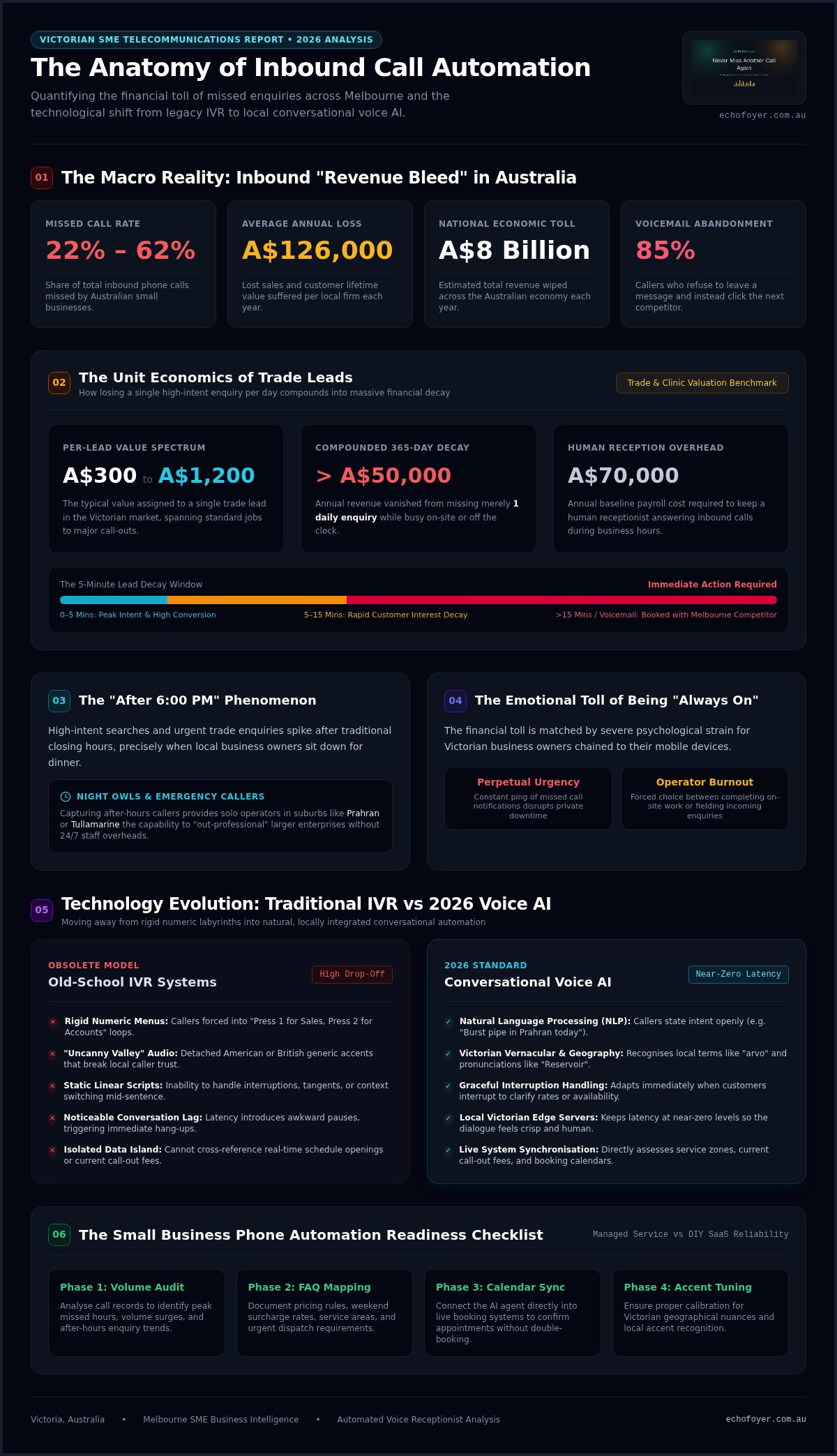
Small business phone automation is a system that answers, routes, and acts on inbound calls without needing a human to pick up the receiver. It's more than just a digital receptionist. It's a managed workflow that ensures every enquiry is handled instantly. For many Melbourne business owners, the phone is a "leaky bucket" that drains potential profit before they even realise it's happening. Recent studies indicate that Australian SMEs miss between 22% and 62% of their calls. If you're a local plumber or clinic owner, missing just one high-intent call per day can be devastating. With trade leads often valued between A$300 and A$1,200, losing one daily enquiry adds up to over A$50,000 in lost revenue every year. This "revenue bleed" contributes to an estimated A$8 billion annual loss across the Australian economy.
Beyond the financial hit, there's a significant emotional toll. The constant ping of a missed call notification creates a sense of perpetual urgency. Many owners feel they must be "always on" to survive, which leads to burnout and strained personal lives. While legacy setups relied on traditional Interactive Voice Response (IVR) systems that frustrated callers with rigid numeric menus, modern small business phone automation uses conversational AI to handle tasks naturally and professionally.
Why Voicemail is Where Leads Go to Die
In 2026, the modern consumer's patience has vanished. If you don't answer, 85% of callers won't leave a message; they'll simply click the next business on Google. Voicemail is a dead end that forces you to do the work later. An automated agent provides an active path by booking the job or answering the question right then. In the Victorian trade sector, lead decay is the rapid loss of a potential customer's interest or availability when a business fails to respond within the first five minutes of an enquiry. By the time you listen to that voicemail and call back, the lead has usually booked with a competitor who answered first.
The 24/7 Advantage in a Competitive Local Market
Many high-intent searches happen after 6:00 PM when you're finally sitting down for dinner. After-hours automation captures these "night owls" and emergency enquiries that would otherwise go unanswered. Having a system that handles these calls with a professional, local tone builds massive brand authority. It allows a solo operator in suburbs like Prahran or Tullamarine to "out-professional" much larger companies. You can offer immediate, around-the-clock engagement without the A$70,000 annual overhead of a human receptionist. This constant availability gives you a distinct edge in a crowded Melbourne market.
Voice AI vs. Old-School IVR: What Actually Works in 2026?
The era of "Press 1 for Sales" is finally over. Traditional phone menus, known as Interactive Voice Response (IVR) systems, have long been a source of frustration for local customers. They're rigid, slow, and often lead to high drop-off rates. Modern small business phone automation has moved beyond these clunky barriers. Today, Natural Language Processing (NLP) allows your callers to speak naturally. Instead of navigating a numeric maze, a customer can simply state their problem. They might say, "I've got a burst pipe in Prahran and need someone today." The system understands the intent, extracts the location, and moves straight to the solution.
One of the biggest hurdles in previous years was the "uncanny valley" effect of robotic American or British voices. In 2026, accent training is a non-negotiable requirement for the Australian market. A local AI receptionist needs to understand Victorian geography and our specific vernacular. Whether a caller mentions an "arvo" appointment or mispronounces "Reservoir," the system stays in sync. These agents also integrate with your live business data. They don't just follow a static script; they know your current call-out fees, your service areas, and your real-time availability.
Conversational Flow and Latency: The Reliability Factors
Response speed is the most critical metric for maintaining trust. If there's a noticeable lag in the conversation, the caller immediately feels they're talking to a machine and hangs up. Modern agents use local Victorian servers to keep latency at near-zero levels. This ensures the conversation feels crisp and human. These systems also handle interruptions gracefully. If a customer stops mid-sentence to ask about your Saturday rates, the AI pivots instantly without breaking the flow. This level of responsiveness is backed by Business Victoria's guide on customer responsiveness, which highlights how being easy to contact is the primary driver for local loyalty.
Beyond Answering: Executing Business Tasks
The true value of automation lies in its ability to execute tasks rather than just taking messages. By syncing directly with your live calendar, the system can book jobs and consultations on the spot. This removes the "phone tag" that usually follows a missed call. It also integrates with your local CRM tools to ensure every lead is logged with full context. You can explore how automated booking integration works to see how it handles your specific scheduling rules. This setup ensures you never wake up to a double-booked Monday morning again.
Managed Service vs. DIY SaaS: Choosing the Right Path
Many Melbourne business owners fall into the "DIY Trap" when searching for small business phone automation. They sign up for a global SaaS platform, pay the monthly subscription, and then realise they don't have the ten hours required to configure the logic or test the voice prompts. The software sits idle while calls continue to go to voicemail. A managed AI model removes this burden by providing professional design, setup, and continuous tuning. Instead of wrestling with webhooks or prompt engineering, you get a system that works from day one.
When analysing the total cost of ownership, you must factor in your own hourly rate. A "cheap" A$50 per month software subscription becomes expensive if you spend five hours a month troubleshooting it. A managed service offers a flat fee that covers everything from implementation to ongoing support. This is particularly vital when you consider the Harvard Business Review study on lead response times, which proves that waiting even thirty minutes to respond to a lead can decrease your chances of qualifying them by 21 times. If your DIY setup fails or lags, you're literally paying to lose business.
The Problem with Global "One-Size-Fits-All" Apps
Generic templates often fail to capture the specific nuances of a Melbourne plumbing or dental practice. A global app won't know the difference between a routine check-up and an emergency tooth extraction in a local context. Custom knowledge base training using your actual business data is essential for accuracy. Local support in Victoria means more than just a time zone match; it's about having a partner who understands the local market conditions and can be reached immediately without waiting 48 hours for a global support ticket to be processed.
Turnkey Solutions: From Call Forwarding to Live Booking
A turnkey solution means EchoFoyer handles the heavy lifting while you stay on the job. We manage the AI Receptionist Setup and Appointment Booking Integration so you don't have to become a tech expert. As your business grows, your AI agent needs ongoing tuning to reflect new services or pricing. For business owners who value their time over DIY tinkering, choosing a managed Victorian specialist is the only logical path to reliable automation. This approach allows you to focus on your craft while your communications remain in expert hands.
The Small Business Phone Automation Readiness Checklist
Before you deploy small business phone automation, you need to understand where your current gaps are. Start by auditing your call logs from the last month to see exactly when you're missing the most leads. Are these calls coming in during the lunch rush, while you're on-site, or after 6:00 PM? Identifying these peaks ensures your AI agent is configured to cover the times when your revenue bleed is highest. You also need to confirm your current phone provider, such as Telstra or Optus, supports call forwarding. If you can't redirect your calls to a secondary number, the most advanced system won't be able to catch those leads for you.
Identifying your core "Frequently Asked Questions" is the next vital step. What do callers always ask first? Usually, it's about your service area, your call-out fee, or your next available opening. Documenting these answers allows the AI to handle the bulk of your enquiries without ever needing to interrupt your day. Defining clear escalation rules is also essential. You need to decide when the AI agent should hand off to a human, such as for emergency jobs or complex project disputes that require your personal attention.
Step 1: Mapping Your Customer Journey
Every successful setup begins with a clear "Critical Path." This is the journey from the first "Hello" to a confirmed booking in your calendar. You should separate your calls into two categories: routine and complex. Routine calls include booking requests and pricing enquiries, which are perfect for automation. Complex calls require a human touch. By organising your service list and pricing for AI training, you ensure the system provides accurate, helpful information rather than vague responses. This level of detail builds trust with the caller from the very first second.
Step 2: Technical and Operational Prerequisites
Implementing small business phone automation requires your digital calendar to be the "Source of Truth." Whether you use Google, Outlook, or a medical platform like Cliniko, your availability must be kept up to date in real-time. If your calendar is messy, you'll end up with double-bookings that damage your local reputation. You also need to test your mobile signal and forwarding settings in the areas where you usually work. It's helpful to learn how to forward calls to your AI receptionist before you go live to ensure a seamless transition.
Once these technical basics are in place, you can move from reactive "firefighting" to a proactive business model. You don't need to be a tech specialist to get started; you just need a clear map of how you want your customers to be treated. If you're ready to stop the lead leak, you can book a readiness audit with EchoFoyer to see how these steps apply to your specific Victorian business. We handle the technical heavy lifting so you can stay focused on your actual work.
Building Your Local AI Receptionist with EchoFoyer
EchoFoyer provides a turnkey solution for small business phone automation that eliminates the technical friction of DIY platforms. Our process begins with a custom design phase where we map out your specific business logic and customer journey. Because we're locally owned and operated in Victoria, our training involves calibrating the AI to understand the nuances of the Melbourne market. We don't just hand you a login; we handle the AI Receptionist Setup and provide ongoing tuning to ensure the agent remains accurate as your business evolves.
Choosing a local partner means you aren't waiting on a global support ticket for a minor change. If your pricing changes or you add a new service, our Victorian-based team updates your agent promptly. This managed model provides a "set and forget" peace of mind that global apps simply cannot match. We act as a professional extension of your brand, ensuring every caller feels heard and every lead is captured. This reliability allows you to focus on your work without the constant distraction of a ringing phone.
Tailored for Melbourne Industries
We build specific agents for various sectors, ensuring the AI understands industry-specific terminology. For tradies, this might mean identifying high-priority emergency calls like gas leaks or electrical faults after hours. In a medical clinic setting, the agent handles patient bookings through live calendar integration, following your specific rules for appointment types and durations. This "Melbourne factor" ensures that whether a caller is in Footscray or Frankston, they receive a professional response that reflects your local standards. Our Victorian-based development team ensures that the tone is always helpful and reassuring, never robotic.
Getting Started: Your First 48 Hours with AI
The transition to small business phone automation is faster than you might expect. After an initial consultation to gather your business data and FAQs, we can often have your system live and handling calls within 48 hours. You don't need to learn any new software or manage complex dashboards. You can monitor your agent's performance through live transcripts and concise lead summaries sent directly to your phone. This transparency ensures you stay in control while the AI handles the repetitive front-line work. If you're ready to stop the stress of missed calls, see how EchoFoyer organises your reception with a system that never sleeps.
Secure Your Future Revenue Today
The landscape of customer engagement has shifted. Relying on voicemail or clunky menus is no longer a viable strategy for Victorian businesses. By adopting small business phone automation, you eliminate the revenue bleed that comes from missed enquiries. You've seen how modern, conversational AI can handle bookings and FAQs with a local touch, allowing you to focus on the work that actually pays the bills.
Choosing a managed approach means you don't have to be a tech expert to benefit from 24/7 coverage. EchoFoyer is locally owned and operated in Victoria, offering a turnkey setup where we build the system and you reap the rewards. We provide ongoing Victorian-based support and agent tuning, ensuring your business never misses a lead again. It's time to stop feeling tethered to your phone and start growing your brand with confidence.
Ready to transform your reception? Book a discovery call with our Melbourne team to see how we can organise your communications. You've got the skills; let us handle the calls.
Frequently Asked Questions
Will an AI receptionist sound robotic to my Melbourne customers?
Modern voice agents are built using advanced speech-to-speech technology that eliminates the clunky, robotic feel of the past. We specifically train our agents on Australian vernacular and Victorian geography to ensure they sound like a local professional. Your customers will experience natural turn-taking and context-aware responses. This ensures that whether someone is calling from Prahran or Frankston, they feel they're speaking with a helpful assistant rather than a rigid machine.
How does the AI agent book appointments into my existing calendar?
Our small business phone automation system integrates directly with your existing digital calendar, such as Google Calendar, Outlook, or industry-specific tools like Cliniko. During the setup phase, we define your booking rules, appointment durations, and buffer times. When a caller wants to book, the AI checks your real-time availability and places the appointment directly into your schedule. You receive an instant notification, ensuring your source of truth is always up to date.
Can I still answer my own phone if I want to?
You retain full control over how and when the AI handles your calls. Most Melbourne business owners use the system for overflow during busy periods or for 24/7 after-hours coverage. You can set your phone to ring for a specific number of seconds before the AI picks up, or toggle it on only when you're on-site. This flexibility allows you to stay personally connected to your VIP clients while ensuring no new leads are lost.
What happens if a caller has a complex emergency the AI cannot handle?
We define clear escalation rules during your initial setup to handle non-routine enquiries. If a caller describes a situation that falls outside the AI's training, such as a major flood or a legal dispute, the agent can instantly transfer the call to your mobile or flag it as an urgent priority. You'll receive a live transcript of the conversation immediately, allowing you to step in with the full context of the situation already in hand.
Is it difficult to switch my current phone number to an automated system?
You don't need to change your existing business number or switch providers to implement small business phone automation. The system works through simple call forwarding, which is a standard feature with Australian telcos like Telstra and Optus. We provide clear instructions on how to redirect your calls to the AI's dedicated intake line. This means your marketing materials, business cards, and Google Business Profile remain exactly as they are while your responsiveness improves overnight.
Do I need to be tech-savvy to manage a phone automation system?
You don't need any technical expertise because EchoFoyer is a fully managed service. Unlike DIY SaaS platforms that require you to build logic flows and write prompts, we handle the entire design, implementation, and ongoing tuning process from our Victorian base. We act as your technical partner, making updates to your knowledge base whenever your services or prices change. You simply benefit from the results while we manage the backend mechanics.
How much does it cost to set up a turnkey AI receptionist in Australia?
The investment for a turnkey AI receptionist typically consists of a one-time professional setup fee and a recurring monthly subscription. The setup fee covers the custom design and voice training on your specific business data. The monthly subscription ensures 24/7 call coverage and ongoing technical support. Because we tailor the service to your call volume and industry requirements, we recommend a discovery call to provide a proposal that fits your specific business needs.
Can the AI agent handle multiple calls at the same time?
One of the primary benefits of small business phone automation is its ability to handle an unlimited number of calls simultaneously. A human receptionist can only speak to one person at a time, but an AI agent ensures that no caller ever hears a busy signal. This is critical during peak times or lunch rushes when multiple leads might try to reach you at once. Every caller receives an immediate, professional response.


